Showing posts with label yarn. Show all posts

Thursday, October 1, 2015

Dyeing Yarn with Goldenrod

This is a blog post I started last year, when I was in a yarn dyeing frenzy.  It sat as a draft with pictures for months and months... But last week I dyed with Goldenrod again (but forgot to take pictures) so I thought this would be a fitting post.  I have talked about yarn dyeing a few times on the blog, including this post with a more detailed description of the process.

Goldenrod is a wildflower (or weed, depending on who you ask) that grows in empty lots, along highways, and pretty much everywhere in Ohio in the late summer and early fall.  Last year a coworker filled a trashbag for me with the Goldenrod plants growing in his backyard.  This year I was able to scavenge some from an empty lot down by the railroad tracks.  Last year I used the flower, stems, and leaves to make the dye bath, but you can also get nearly the same color from just the flower heads.

I simmered the plant for about an hour before straining out the plant material.  I bought a big mesh ladle thing from the Chinese grocery store and it works great for this!  Meanwhile, I prepared my yarn by mordanting it in a solution of alum.  The yarn came out a beautiful, bright yellow.

I made a TON of dye that day, so I also dyed two additional skeins of yarn and treated them with an iron afterbath.  To get the iron solution I soaked a bunch of rusty nails and other metal bits in a jar with water and vinegar. Then I put the solution in a pot and heated it to almost a boil.  One skein I dipped from the dye bath into the iron bath for about 20-30 seconds (the color changes right before your eyes, it is amazing.)  That one came out a lovely light green.  The next skein I put into the iron bath for longer, probably 1-2 minutes, and it came out a dark forest green.

Tuesday, October 21, 2014

Dyeing Yarn with Queen Anne's Lace

Another one of my natural dye experiments this summer was with Queen Anne's Lace.  In the summertime Queen Anne's Lace is a wildflower that flourishes in empty lots, along highways, and any other green space that does not get mowed.  These flowers remind me of spending summer "up north" at my grandparent's cottage as a kid.  They grew everywhere and where my favorite flowers to pick.  Now that I am making natural dyes, I knew I had to use Queen Anne's Lace somehow.
 
I started by going down to the railroad tracks one August day and cutting giant handfuls of Queen Anne's Lace like I was making a bouquet.  I needed at least 4 oz. of flowers to dye one skein of yarn.  Then I went through the cooking process, strained off the flowers, and dyed 3.5 oz. of wool mordanted in alum.  (You can read more about the dyeing process on my these previous posts.)
 

So far this has been my favorite dye as far as aroma.  Since Queen Anne's Lace is in the carrot family, it has a kind of spicy carrot scent while cooking.  The final product ended up being a light, bright yellow.  Stay tuned for more posts about ecodyeing!  I've dyed about 30 skeins of yarn this summer and fall, and now that the weather is cooler I'm catching up on my blogging.
 

Friday, September 12, 2014

Dyeing Yarn with Blueberries

Another one of my natural dye experiments was dyeing yarn with blueberries.  I started with a skein of 100% wool yarn and pre-mordanted the fiber in Alum.  Mordant helps the yarn to accept color better, and Alum tends to provide the brightest and clearest colors, compared to using copper or iron as mordants.

I made the dye bath using a 1:1 ratio of berries to fiber.  In this case, the blueberries had been left behind in the fridge at work and had started to get wrinkly and soft.  Instead of throwing them in the compost, I took them home for dyeing.  To get the maximum amount of color from the berries, I added a small amount of water to the pot and crushed the berries with a potato masher.  (I did this without the water at first and ended up squirting berry juice everywhere...)
 
After keeping just below a simmer for an hour, I strained out the berry pieces and added the wet fiber.  The dye bath looked like a gorgeous pink/purple, and I was really hoping that would transfer to the fibers.  When the fiber was rinsed and dryed, it ended up looking more like a blue-ish lavender.  It is still a lovely color, but definitely shows how unpredictable natural dyeing can be.
 

Wednesday, September 3, 2014

Dyeing Yarn with Zinnias


As I mentioned in a previous post, my interest in natural dyeing has been renewed.  I have kind of gone crazy with dyeing yarn (which you will see in my next five... or ten... blog posts) starting with zinnia flowers from the garden.

I started out by weighing the flowers and getting a 2:1 ratio of flowers to fiber.  My skeins are 3.5 oz, and I also dyed a small amount of wool for spinning, so I used about 8 oz of zinnias.  Then  I simmered the flowers in my dye pot for about an hour to extract the color, and strained out the flower pieces so it doesn't tangle with the yarn.

The yarn is 100% wool, pre-mordanted in alum so it will accept the color better and be more light-fast.  Before adding the wool to the dye bath, I soaked it in water so it will dye more evenly.  After an hour or so in the hot dye bath, I removed the yarn, let it cool, and rinsed out the remaining dye.  The zinnia dye turned out to be a gorgeous buttery yellow, much more subdued than the turmeric.

Thursday, August 28, 2014

Processing Raw Wool

Most of my friends and blog readers know that I am an avid crafter and artist.  (If you haven't figured that out by now, you really haven't been paying attention...)  I have been crocheting and knitting for many years, and last year my friend Mary taught me how to spin yarn.  Spinning is something that got put on the back burner with all the other things going on in my life, but recently I've had a renewed interest in spinning and natural dyeing.
Part of what fueled my renewed excitement for spinning is this large trash bag full of raw wool!  I made friends with a woman named Diane that had come to Cleveland to take workshops at the Morgan Conservatory where I work.  She has a flock of sheep and three herding dogs.  (I have not seen any of her sheep but I met her dogs, they are adorable and very well behaved.)  On her second visit to Cleveland, she brought me a bag of raw wool from her Leicester sheep, half white wool and half black.  Now that I have the raw materials there is no excuse not to spin!

Before I could start spinning, I had to learn about processing raw wool.  Raw wool has a combination of dirt, grass, and lanolin embedded in the fibers.  Lanolin is a waxy substance secreted by sheep to help protect their skin.  Lanolin helps make the wool waterproof, but it also feels oily and is more difficult to work with than clean wool.  To clean the wool I filled a bucket with very hot water, added several squirts of dawn dish soap, and let a bunch of wool sink into the water.  It is necessary to use very hot water so the lanolin can melt out of the wool and get absorbed by the dish soap.  Once the wool is in the water, don't touch it.  Heat and agitation together will felt the wool into a blob.  After 15-20 minutes, remove the wool from the bucket, pour out the dirty water, and start again.  I soaked the wool 2-3 times in hot soapy water and 2-3 times in clean hot water to remove the soap.

Once the wool is clean, use a towel to gently squeeze out excess water.  Don't wring out the wool or it will turn into a blob.  I spread my clean wool out on a folding drying rack with a mesh top so air can get above and below, and help it dry faster.  If that is not available, a towel on the floor will work fine.  After the wool is dry, there are still a few pieces of grass and dirt tangled in the fibers, and a little bit of lanolin holding the ends of each lock together.  To help clean and detangle the fiber I purchased a set of hand carders.  The hand carders basically brush the wool and loosen the fibers so the remaining dirt particles can fall out.  After carding, I remove the wool and roll it into a cylindrical thing called a rolag.  These rolags can be used to draft the fibers for spinning.

So there you go!  That is how I got from a bag of raw wool to being ready to spin.  I have cleaned 3-4 buckets of white fiber, 2 of black fiber, and I have only made a dent in the amount of fiber left to clean.  Needless to say, this will keep me spinning through the whole fall and winter.  I have enjoyed using the clean wool in my natural dye experiments.  Pretty soon I will have my own hand dyed and hand spun yarn.

Monday, August 25, 2014

Dyeing Yarn with Turmeric

So I actually dyed this yarn almost a year ago.  I had been putting off taking photos of the yarn and finishing the blog post... But now that I am getting back into natural dyeing and will be posting more of my experiments with natural dyes, I figured it was time to actually post this.

I participated in a local CSA program (community supported agriculture) which gives members a bag of fresh vegetables every week.  One week the bag included fresh Turmeric grown in the hoop house.  The turmeric root is bright yellow and usually used in curry and other similar dishes.  I already had a container of good ground turmeric in my spice rack, so I decided to use the fresh stuff to dye yarn.


I started by cleaning the roots and chopping them into small pieces.  The more surface area that is exposed, the easier it is to extract all the color available into the dye bath.  I added the chopped pieces to a pot of water and simmered for an hour or so to extract the dye.  (Note: I have a special pot set aside for dyeing, that is not used for food.)  I noticed that the dye wasn't very strong, so I supplemented the chopped roots with a teaspoon of ground turmeric from the pantry.

Luckily turmeric does not require a separate mordant to dye effectively.  Mordants prepare the fiber for dyeing so it can accept color from the dye bath.  Certain natural dye stuffs have a natural mordanting agent, so the fiber does not need any pre-treatment.  I took my ball of Paton's Classic Wool and wound it into a large loop so it could move freely in the dye bath.  After securing the loop, I soaked it in cool water in the sink to remove any bubbles or air pockets from the fiber (this helps the yarn dye more evenly.)


I turned the stove down and added my fiber to the dye pot so it could simmer for an hour or more.  I also added some wool roving to the dye pot, so I could use it for spinning later.  As an experiment I dipped one section of roving into an acidic solution (vinegar) after the dyeing process, and one section in an alkaline solution (baking soda and water.)  Treating dyes fibers in different pH solutions will change the color.  One section of roving turned brighter yellow and the other turned a little redder, and shifted towards orange.

Apparently I fail at documenting my process in photos... Because this is all I've got.  Don't worry, I've done a lot more dyeing since then and I (sort of) got better about taking photos.  Stay tuned for more posts about natural dyeing!

Wednesday, May 7, 2014

Paradise Fibers Yarn Club: February


https://www.flickr.com/photos/25370403@N08/12960740494/in/photostream/
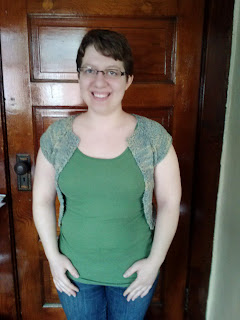
I've been done with this project for a while, but was waiting to get the January yarn club finished and posted first.  The Paradise Fibers Yarn Club for February was a skein of Mountain Colors Merino Ribbon in the colorway Harmony Aspen.  The colors in this one are absolutely gorgeous!  It is a really subtle blend of tan, blue, and green.  Also, remember how I said there was only one of the Mountain Colors novelty yarns I would consider using again?  This yarn was it, and it is much nicer to work with on its own (away from the weird fuzzy yarns.)

https://www.flickr.com/photos/25370403@N08/12960305925/in/photostream
I decided to make a little shrug for spring and summer.  I found an easy pattern on Ravelry from the book One-Skein Wonders that was perfect.  It worked up fairly quickly and didn't have any seaming or grafting.  I added several rows beyond what was called for in the pattern (or else it would have been super short.)  This is the kind of pattern that can be extended until you run out of yarn.

https://www.flickr.com/photos/25370403@N08/13206124953/
Overall, I enjoyed working with the Merino Ribbon yarn.  The color was perfect and it made a nice light fabric.  I would probably buy this yarn again for a summer sweater, or other warm weather knitting.
https://www.flickr.com/photos/25370403@N08/13206293894/in/photostream/

Thursday, May 1, 2014

Paradise Fibers Yarn Club: January

https://www.flickr.com/photos/25370403@N08/12597215963/
I have been participating in the Paradise Fibers yarn club since last summer.  The yarn for January was Mountain Colors Twizzle in the color Evening Star.  It is a lovely worsted weight Merino wool with a strand of silk plied in.  The silk adds a lovely pop of color to the yarn.  Evening Star is a black and purple base with orange and blue accents.

https://www.flickr.com/photos/25370403@N08/12597205423/
Since black and purple are my cousin's favorite colors, I decided to make a triangular scarf for her as a birthday gift.  I used the Ashton Shawlette pattern that I made for myself in the fall.  Unfortunately I didn't check the yardage before I started, so I ran out of yarn less than a week before the project deadline!  So I ordered a second skein and finished it later.

https://www.flickr.com/photos/25370403@N08/14040896332/
I had to keep setting this project aside for other things (like yarn club projects for February and March, and both of my big ice skating competitions this year...) but I finally finished the shawl over the weekend and got it blocked.  Now that this is done, I can post about the other yarn club projects I finished in the meantime!

Friday, February 28, 2014

Paradise Fibers Yarn Club: December

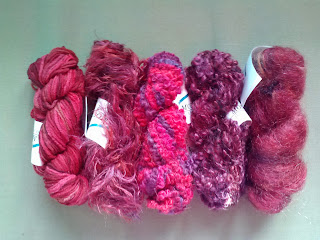
The Paradise Fibers yarn club project for the month of December was a scarf kit with 5 one-ounce skeins of natural fiber novelty yarns.  The yarns in the kit were: Merino Ribbon (a flat open ribbon), Wooly Feathers (sort of hairy like fun fur), Missoula (a springy textured yarn), Mohair Loop (a curly yarn), and Mohair.  All the yarns were in the red/magenta color family with a few touches of purple.

http://www.flickr.com/photos/25370403@N08/12842880494/
Honestly, this is the first month of yarn club that left me unhappy with the yarn choice.  I hate novelty yarns, and the colors this month are my least favorite.  The project was a chunky scarf that basically alternated rows of all the different novelty yarns.  I knit the entire scarf in one day while the city was shut down during the first "polar vortex".  It was something like 13 degrees below zero, before windchill... So knitting was the perfect distraction.  Out of all five yarns, the only two I would consider buying again are Merino Ribbon and Missoula.  They are the least weird out of the bunch.

http://www.flickr.com/photos/25370403@N08/11951684044/
Like I said, this is my least favorite yarn so far... And I mostly knit the scarf to get my $10 in store credit.  I'm hoping to find a friend, family member, coworker, (or even a random stranger) that loves red and can rock this scarf.  It is not really my style, but I know somebody out there would absolutely love it.  Leave a comment if that somebody is you!  (Seriously, I'll send you the scarf.)  Edit 3/4/14- I found an owner for the scarf!  My good friend Fenna from The Honest Badger.  Hopefully I can get a picture of her wearing the scarf to post here.

Tuesday, February 18, 2014

Paradise Fibers Yarn Club: November


http://www.flickr.com/photos/25370403@N08/12549648774/
I realize this post is way overdue, but I finally finished my yarn club project for the month of November.  The deadline for the project was the night before my last holiday craft show.  Between creating inventory for shows and making Christmas presents, this project just didn't get done in time.  The yarn for November was River Twist by Mountain Colors in the colorway Rock Creek.  It is a lovely 100% merino that is plied with two strands that change colors.  Rock Creek is a blend of dark gray, blue, green, and purple.  It almost looks black at first glance, then you notice all the muted colors.

http://www.flickr.com/photos/25370403@N08/11310987486/in/photostream/
The project for the month was a hat with cables called Intersections Break.  I like working with cables and the pattern was easy to follow.  The only thing I didn't like about the pattern was how they figured out the sizes.  My gauge was correct, so the circumference of the hat was fine, but the number of cables for the "small" hat wouldn't have even covered my ears.  I realized this after starting the decrease rows on the evening of the project deadline.  After ripping back a few rows it became clear that I wasn't going to finish 2 more cable repeats and the decrease that evening so I set the project aside.

http://www.flickr.com/photos/25370403@N08/12549138365/in/photostream/
In the meantime I finished knitting my Echo Lodge sweater and picked up again on my colorwork socks from last year.  I also finished the yarn club project for December, which will be posted soon!  This hat ended up being a Valentine's gift for my guy.  Overall, I like the River Twist yarn and would probably order it again for another project.

Tuesday, January 21, 2014

Echo Lodge Sweater

One of my big knitting projects this fall/winter was to knit a sweater.  I had bought a lovely, chunky, baby alpaca yarn over a year ago with the intention of making a sweater... and I didn't get around to it before the weather got warm.  In October I found a great pattern book of sweaters called Tundra: Elements.  The author describes the book as a choose-your-own adventure book, but for knitting sweaters!  There is a basic raglan sweater pattern, and then each pattern has a special element that can be mixed and matched to make a custom sweater (collar options, stripes, v-neck, etc.)

http://www.flickr.com/photos/25370403@N08/12059820485/in/photostream/
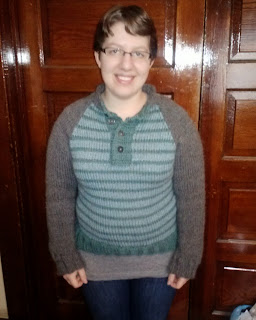
The sweater I chose is called Echo Lodge.  I made it with blue and blue/green stripes on the body, gray sleeves, and a blue/green button placket.  From start to finish it took me three months to finish.  Based on the rate I normally complete projects, this was excellent!  Especially considering I knit this in between my yarn club projects, making Christmas gifts, and having four holiday craft shows.

http://www.flickr.com/photos/25370403@N08/12060726056/in/photostream/
I'm very pleased with how the sweater came out.  It is really soft, and nice and warm for winter.  However, it is super fuzzy... and I end up shedding on things while I'm wearing it!  I'm hoping that will go away once I wash (or soak) the sweater once.  I kinda skipped that step in the instructions because I wanted to wear it right away.  *Side note: while I was knitting, this sweater was the cat's absolute favorite!  So I included a picture of Frankie enjoying the sweater too.

Tuesday, December 10, 2013

Paradise Fibers Yarn Club: September


http://www.flickr.com/photos/25370403@N08/11310704825/
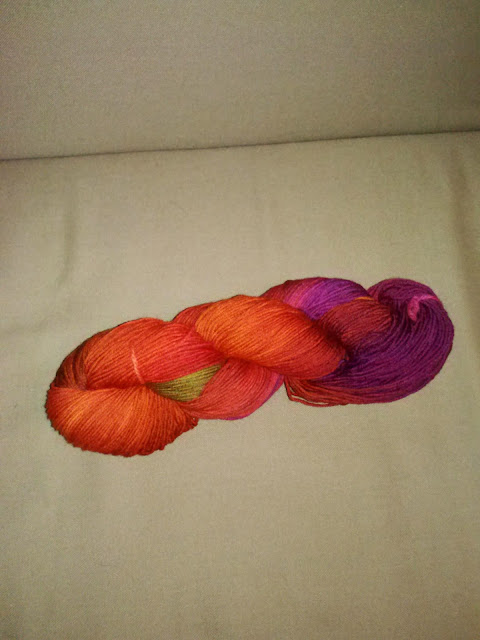
I am woefully behind on posting about my monthly yarn club projects.  For the month of September the yarn was Mountain Colors Crazyfoot in the color Poppy Trail.  The yarn is a fingering weight Merino with a little bit of nylon.  The color was a blend of orange, pink, red, and green- great fall colors!  (It was still actually fall when I was received the yarn and started knitting...)

http://www.flickr.com/photos/25370403@N08/11310462803/in/photostream/
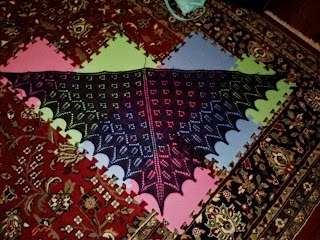
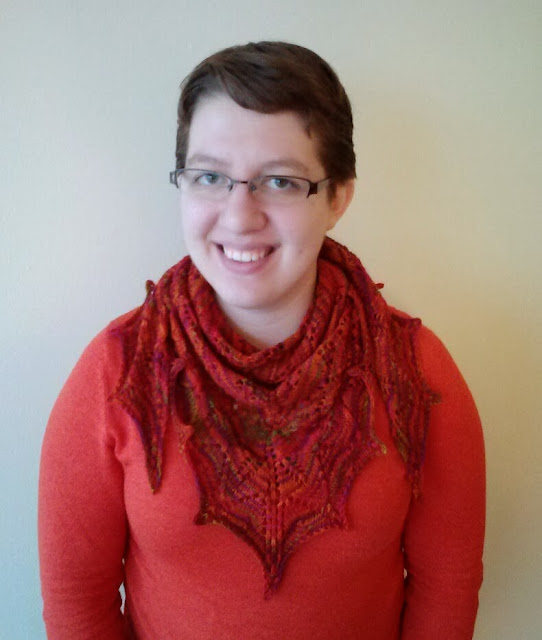
The suggested project for the month was a pair of socks.  Since I had done a pair of socks last month, I decided to make a lace shawl/scarf.  I chose the Ashton Shawlette because of the pointy scallops on the edges.

http://www.flickr.com/photos/25370403@N08/10397113293/in/photostream/
The pattern was easy to follow and worked up pretty quickly.  I managed to finish knitting within minutes of the October 20th deadline.  And then it sat unblocked in my room for over a month... oops!

http://www.flickr.com/photos/25370403@N08/11310492433/in/photostream/
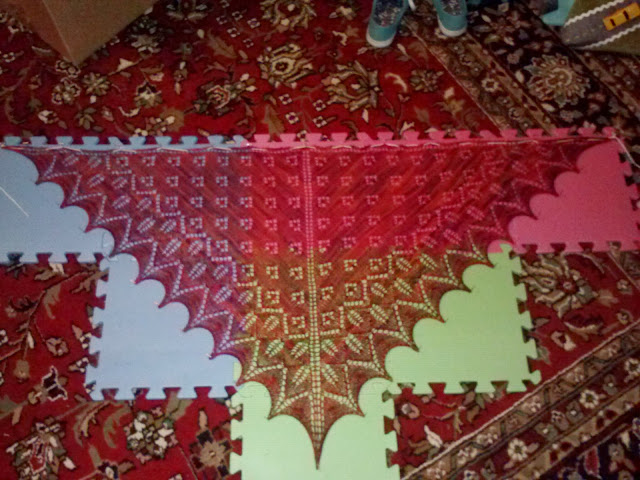
Last week I used my Paradise Fibers store credit to get a set of foam blocking mats.  They are squares that fit together in different shapes, and then you can pin items to them for blocking.  I finally blocked the shawl and it looks great!  I'm always amazed at how much bigger a project like this turns out after blocking.

http://www.flickr.com/photos/25370403@N08/11310465013/in/photostream/
And here's a bonus photo of Frankie helping me with my knitting!
http://www.flickr.com/photos/25370403@N08/11310379475/

Wednesday, September 25, 2013

Paradise Fibers Yarn Club: August

This month's yarn club package had a skein of Mountain Colors Bearfoot sock yarn in Lilac.  It is a lovely blend of superwash wool, mohair, and nylon in a blend of navy blue, purple, and blue-green.  The pattern that came with the package was for a pair of fingerless gloves.  I discovered that the pattern is just a "suggested pattern" and as long as I use about the same amount of yardage, I can make whatever I want and still get the $10 store credit!
Since I just finished a nice pair of fingerless gloves earlier in the year (and the pattern provided had eratta and a few sizing issues) I opted to make a pair of socks instead.  I wear warm socks all winter long at work, so it would be nice to have a third pair of basic handmade socks.  I used my favorite sock pattern from the book "How to Knit Socks: Three Methods Made Easy."

This month I was slowed down by a trip out of town, two craft shows, and a massive ear infection.  I was also working on a few baby items for a friend of mine that is due very soon.  (More on those projects later.)  I found myself five days out from this month's deadline with only a half inch started on the second sock!  So I knit furiously on my day off and after work every day that week... And somehow managed to get it done!  I think that is the fastest I have ever knit a pair of socks.  (Huge thanks to my boyfriend for not minding that our "date night" was watching episodes of Community on Hulu while I finished knitting the second sock...)

So far having a deadline has really helped me finish the projects I'm starting.  Next month's box has already arrived and I started knitting a lace shawl over the weekend.  I've also got a plan for my store credit: get another skein or two of Cascade Baby Alpaca Chunky and make the sweater I wanted to make last year.

Sunday, August 11, 2013

Paradise Fibers Yarn Club: July

Last month I signed up for a year long yarn club through the yarn store Paradise Fibers.  Joining the yarn club means that every month Paradise Fibers will send me a mystery package with pretty new yarn and a knitting pattern.  As part of the deal, if I finish the project within a month and post it on Ravelry then I get $10 in store credit!

The first month of the club included a skein of Monarch by Mountain Colors in the color Harmony Aspen, and a pattern for a faux cabled mobius cowl.  I was SO excited to get the box in the mail and get started.  To make things even better, the yarn happened to be in my favorite colors.

It took me about 3 weeks to finish the project.  I had a lot of other things going on last month, so my knitting time was fairly limited.  The box for August should be arriving sometime this week!  I'll be sure to post about next month's project once it gets here.

Friday, August 9, 2013

Ecodyeing: Paper and Yarn

July was a very busy month for me in terms of art. Basically, I've been making things faster than I could possibly blog about them! In an effort to catch up, I'm writing a bunch of blog posts this week about my recent projects.
As part of my job at the Morgan Conservatory I have the opportunity to meet many wonderful artists, specifically in the areas of paper, print, and book arts. One of the artists that came through recently was Velma Bolyard. She spent the weekend in Cleveland teaching a workshop on ecodyeing, and I was around to take pictures and watch the process. The workshop students layered plant material, paper, and occasionally pieces of metal, tied them up with string into bundles.  The prepared bundles get boiled in a large pot of water for several hours. The best part of the process is unwrapping the bundles and rinsing off the plant material to reveal the patterns and colors left behind by the plants.
I was around that weekend observing the process, and Velma encouraged me to make a couple bundles of my own. I used scraps of the cotton paper I usually use for book pages. The paper tore in a few places, but the results were still thrilling! I ended up using the dyed paper as part of an abstract art book.
While cleaning up after the workshop, there was still a large bag of Staghorn Sumac leftover. I took a gallon Ziploc full, and used it to dye yarn the next day.
I've dyed yarn before, but this was secondly the best end result. Mostly because the Sumac has natural tannins that act as a mordant for the yarn.
The fuzzy red bunches from the Sumac created a lovely brown dye bath (and actually smelled really nice while cooking.) I dyed one skein of white wool yarn, and a chunk of wool roving for spinning. The process took the whole day, but it was definitely worth it.