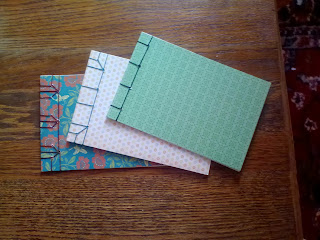
This past weekend I had the privilege of teaching two bookbinding workshops at Scrapbooks Galore and More in Midland, MI. The first two hour class was about Japanese Stab Binding. I had seven eager students, and one indifferent feline assistant. (That is the store mascot Scrapper, enjoying the sunbeam in the middle of our workspace.)
I started by showing the class how to sew a book using the most basic form of Japanese stab binding. For the second and third books, we adjusted the number and location of the holes punched. I let the students figure out some of the sewing on their own, and helped walk them through the difficult parts. Everyone had a great time learning about bookbinding, despite the sore fingers! (I need to remember pliers next time. Pulling the needle through gets a little tough...)
The second two hour class of the day was a Case Bound Book class. This book structure is a little trickier than the Japanese stab binding, so each student only made one book instead of three. This time I had nine students, several of which had taken the earlier class as well. The students learned how to fold signatures, sew together a text block, and glue the text block into a decorative case. Overall it was a great day of teaching, and I am looking forward to teaching again in March at Small Studio in the Cleveland area.