Showing posts with label box making. Show all posts

Thursday, May 28, 2015

Fun With Gelli Plates

A couple weeks ago I decided to experiment and play with using a Gelli Plate.  The Gelli Plate is a brand of reusable, non perishable gelatin printing plate.  It allows you to do monoprinting at home without needing a printing press.  (Remember when I did monoprinting during my printing class in college?)

I used colorful craft acrylic paint, a brayer to apply paint, and a variety of stencils to create patterns.  The process is similar to the monoprinting I had done before, but using a variety of colors instead of only black ink makes a huge difference.  Using the gelli plate was a lot more experimental.  I would often mix colors using the brayer, and print multiple times on the same piece of paper to create depth.


I used one of my favorite prints to cover a small paper mache box from the craft store.  I traced the top of the box and cut a circle of paper for the lid, and cut two paper strips the same height as the side of the box.  Before covering the box with paper, I painted part of the lid blue to coordinate with the print.  I brushed Glue N Seal onto the back of the paper and pressed it onto the box to smooth out any bubbles.  Once all the paper was on, I brushed on another coat of Glue N Seal to protect it.


Every month at my store, I have a group of ladies from a local senior living center come on an art "field trip."  This was their third time out, and I wanted to do something a little different.  So I showed them how to use the gelli plates, and then they covered boxes with their prints.  The ladies had a great time and the boxes turned out just darling.  They are going to use the boxes to hold their "bingo money."  How cute!  I want to go play bingo with those ladies, they are a ton of fun.

Sunday, May 25, 2014

Springtime Folded Book- Art Book 3/14


https://www.flickr.com/photos/25370403@N08/14287999823/in/photostream/
This month I have been experimenting with folded book structures beyond the basic accordion fold.  One of the new techniques I tried is called the Turkish Map Fold.  It is a fold that can be done from both square and rectangular pieces of paper, and opens up to reveal the entire piece of paper.

https://www.flickr.com/photos/25370403@N08/14264503321/in/photostream/
I made this Springtime Folded book from two square pieces of paper.  I started by decorating the flat pieces of paper with image transfer, colored pencil, and a quote about spring by Ruth Stout.  Once the decorations were done, I folded each piece into a Turkish Map fold.

https://www.flickr.com/photos/25370403@N08/14267417304/in/photostream/
Next, I cut one long piece of book board to fit beneath the two folded pieces, and two smaller pieces of book board for each side of the front cover.  Then I glued the boards to decorative papers, leaving space for the front covers to hinge open, and attached ribbon closures.  Finally, I glued down the top and bottom sections of each folded piece to the finished covers.

https://www.flickr.com/photos/25370403@N08/14267416334/in/photostream/
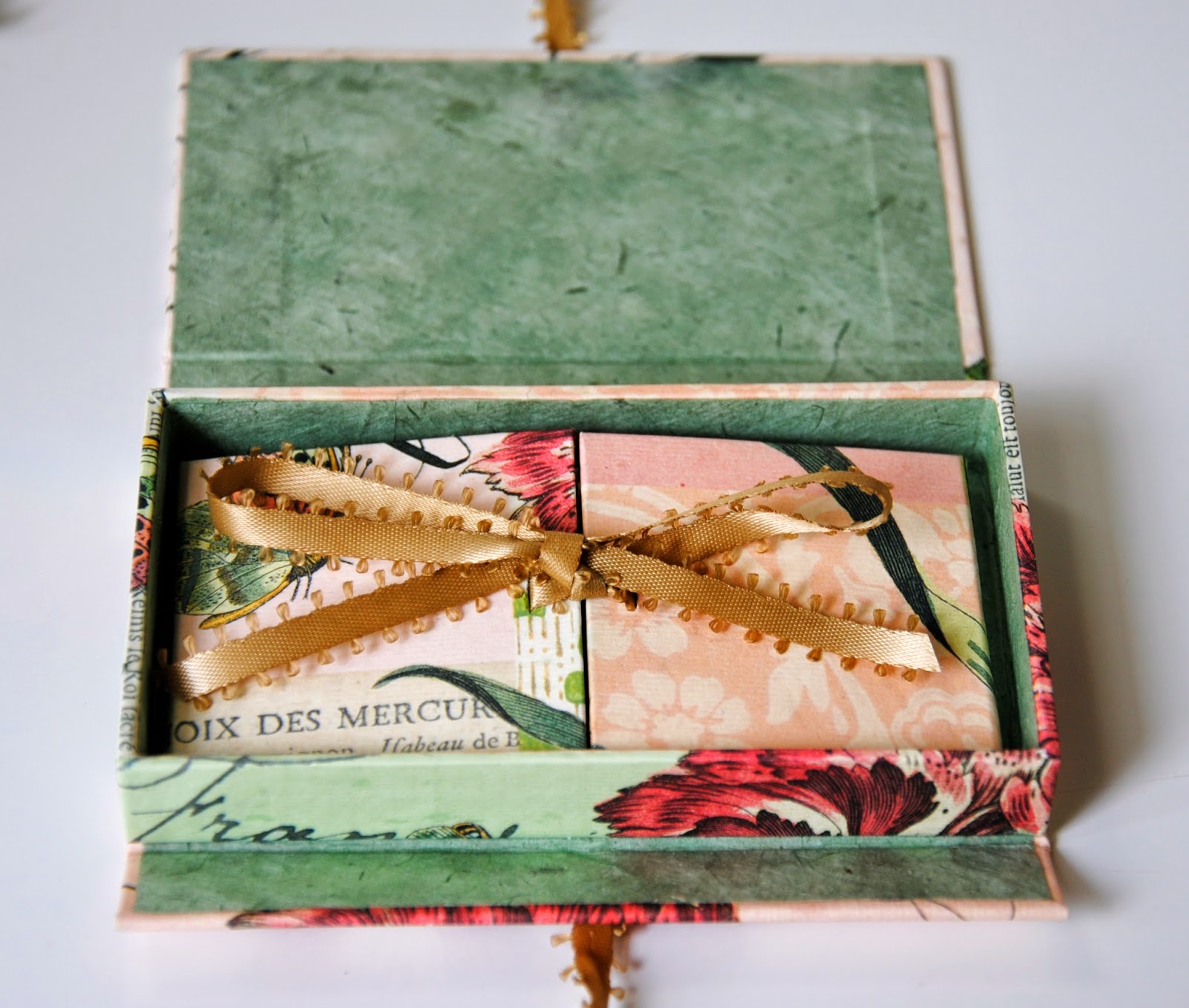
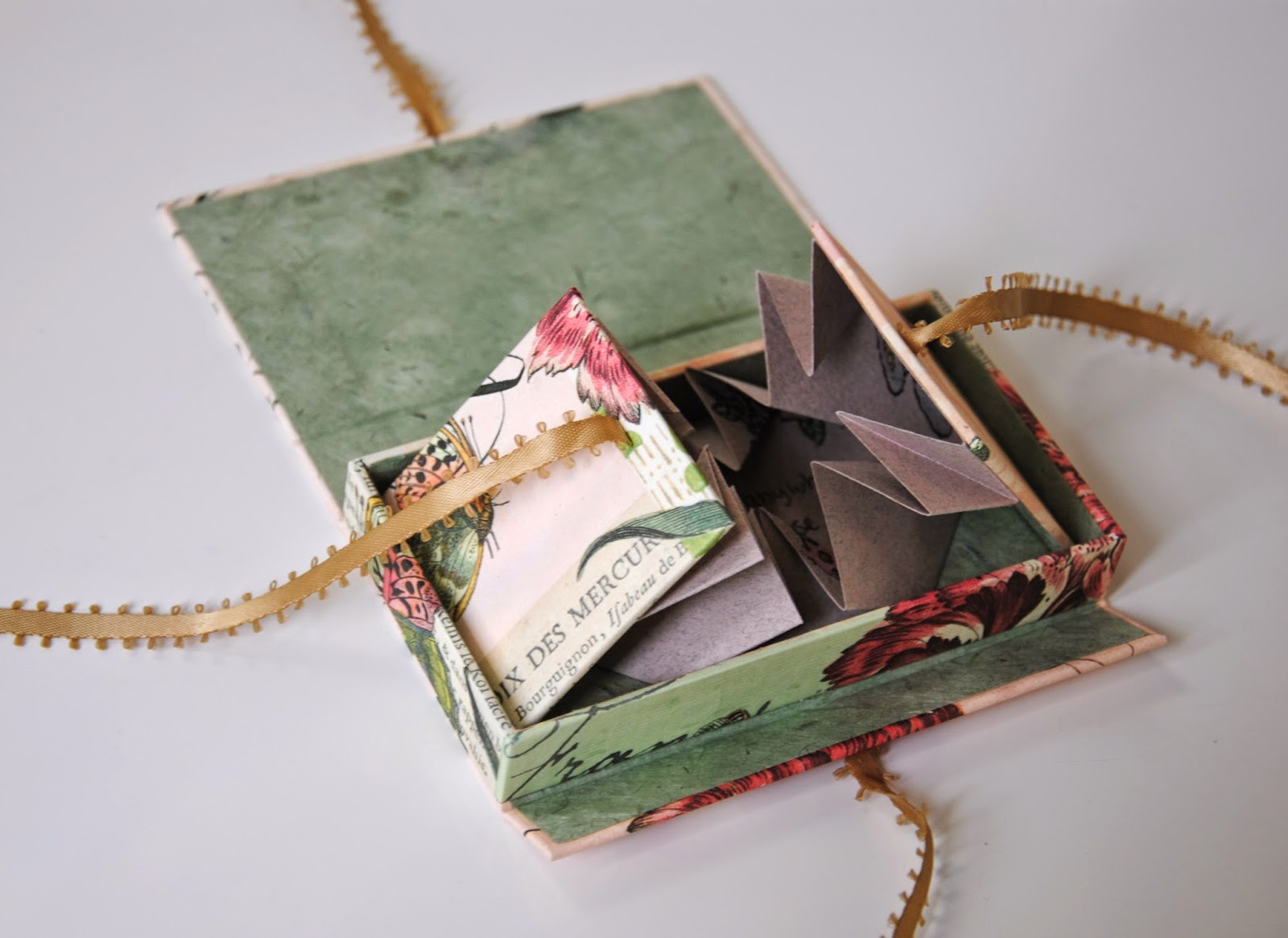
After finishing the book, I thought it would be nice to have a matching box to put it in.  I've been getting more into box making recently, so it was also a great opportunity to practice what I learned in the cartonage workshop I took last summer.

https://www.flickr.com/photos/25370403@N08/14267415324/in/photostream/
The box has a tray for the book and a hinged case that wraps around the tray and ties shut.  I made the entire box by hand using scraps of book board, patience, and a little bit of math.  This book and box are number 3 out of 14 Art Books in 2014.

https://www.flickr.com/photos/25370403@N08/14081166349/

Friday, April 18, 2014

The Solar System- Art Book 2/14


https://www.flickr.com/photos/25370403@N08/13925346055/
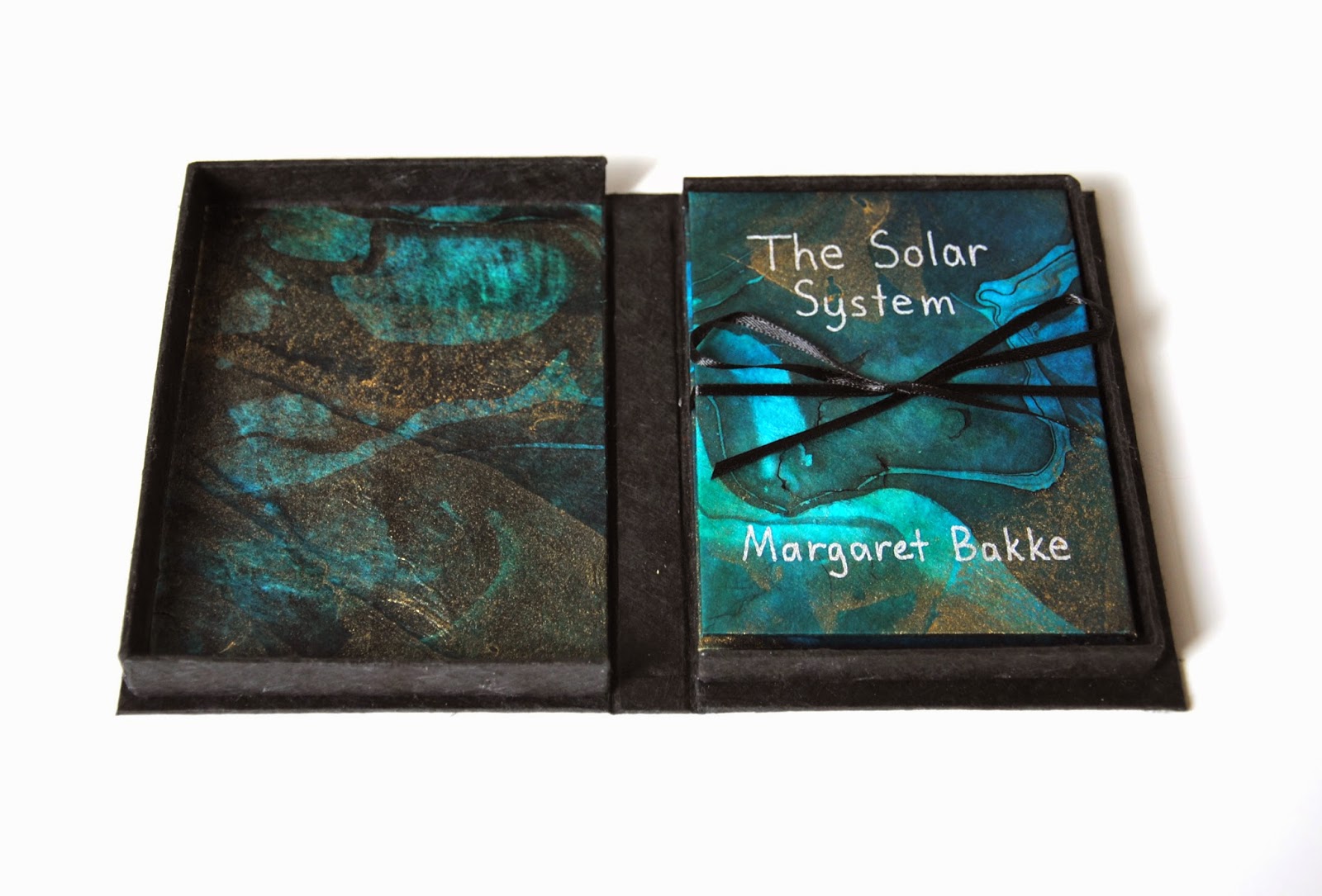
My latest art book is an accordion book of the Solar System with a matching clamshell box.  This is art book 2 of 14 for my 14 in 2014 Challenge.

https://www.flickr.com/photos/25370403@N08/13925818584/
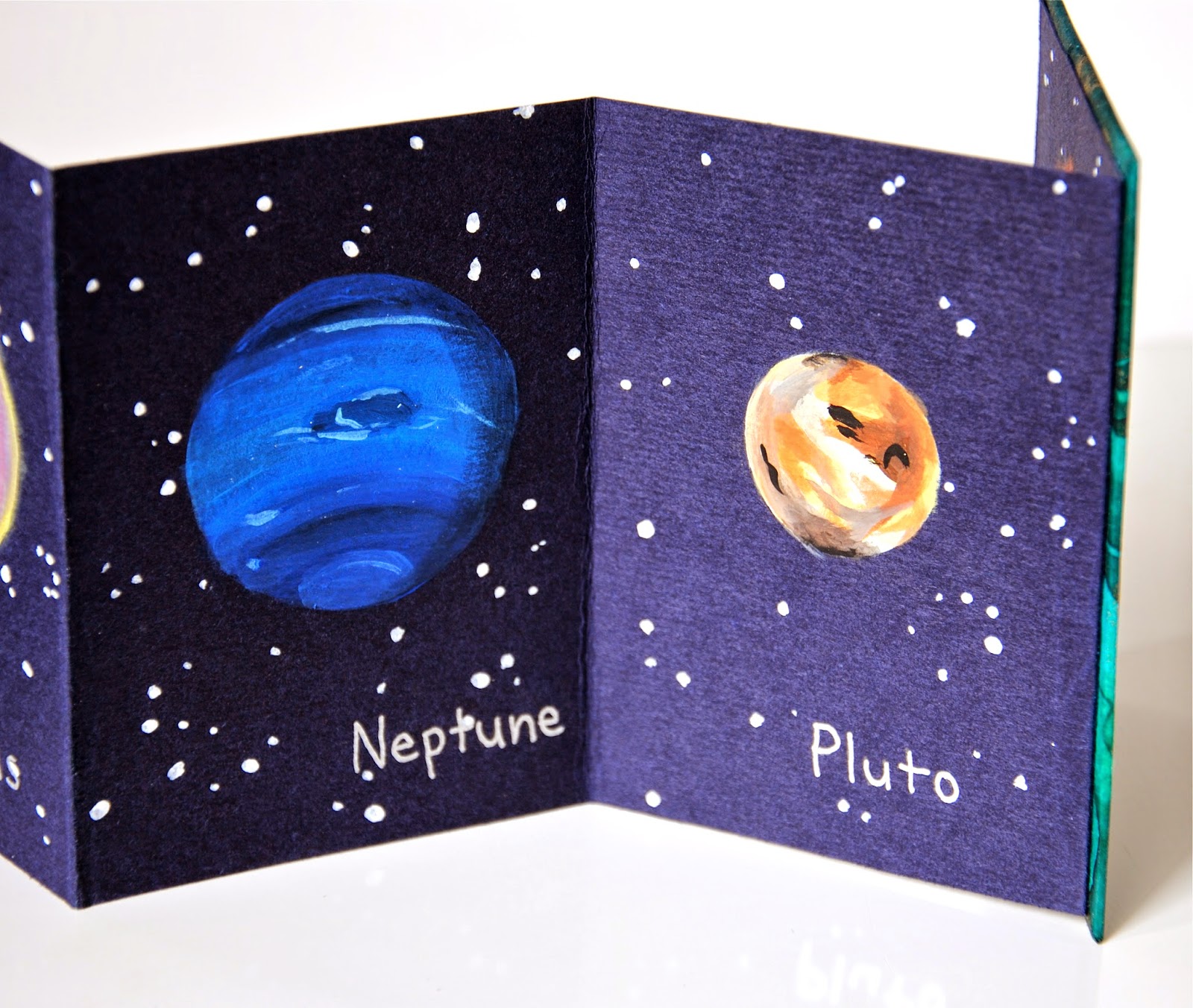
This book is a follow up to the Astronomer's Alphabet and the Aurora Borealis books I made back in 2012.  The accordion is a lovely navy blue cardstock with a different part of the solar system on each panel.  The book starts with the Sun, and ends with Pluto.  (I know Pluto isn't technically a planet anymore, but I still consider it to be part of our Solar System.)

https://www.flickr.com/photos/25370403@N08/13925815794/
I started by folding the accordion, and using pencil to draw the outline of each planet.  Then I painted each planet using several layers of acrylic paint.  I referenced photos from NASA to try and get an accurate representation of each planet.  Then I added dots of white paint for the stars.  Finally, I wrote the name of each planet at the bottom of the page.

https://www.flickr.com/photos/25370403@N08/13902242631/in/photostream/
This was my first time making a custom clamshell box for an art book.  I found a very useful tutorial about how to get the measurements correct, and combined that with my previous box making experience.

https://www.flickr.com/photos/25370403@N08/13925396423/in/photostream/
Since this book is the same size as the Aurora Borealis book, I made a box for each of them at the same time.  Both books are going to be part of an exhibition in April.

https://www.flickr.com/photos/25370403@N08/13925362355/in/photostream/

Thursday, August 22, 2013

Box Making with Steve Pittelkow

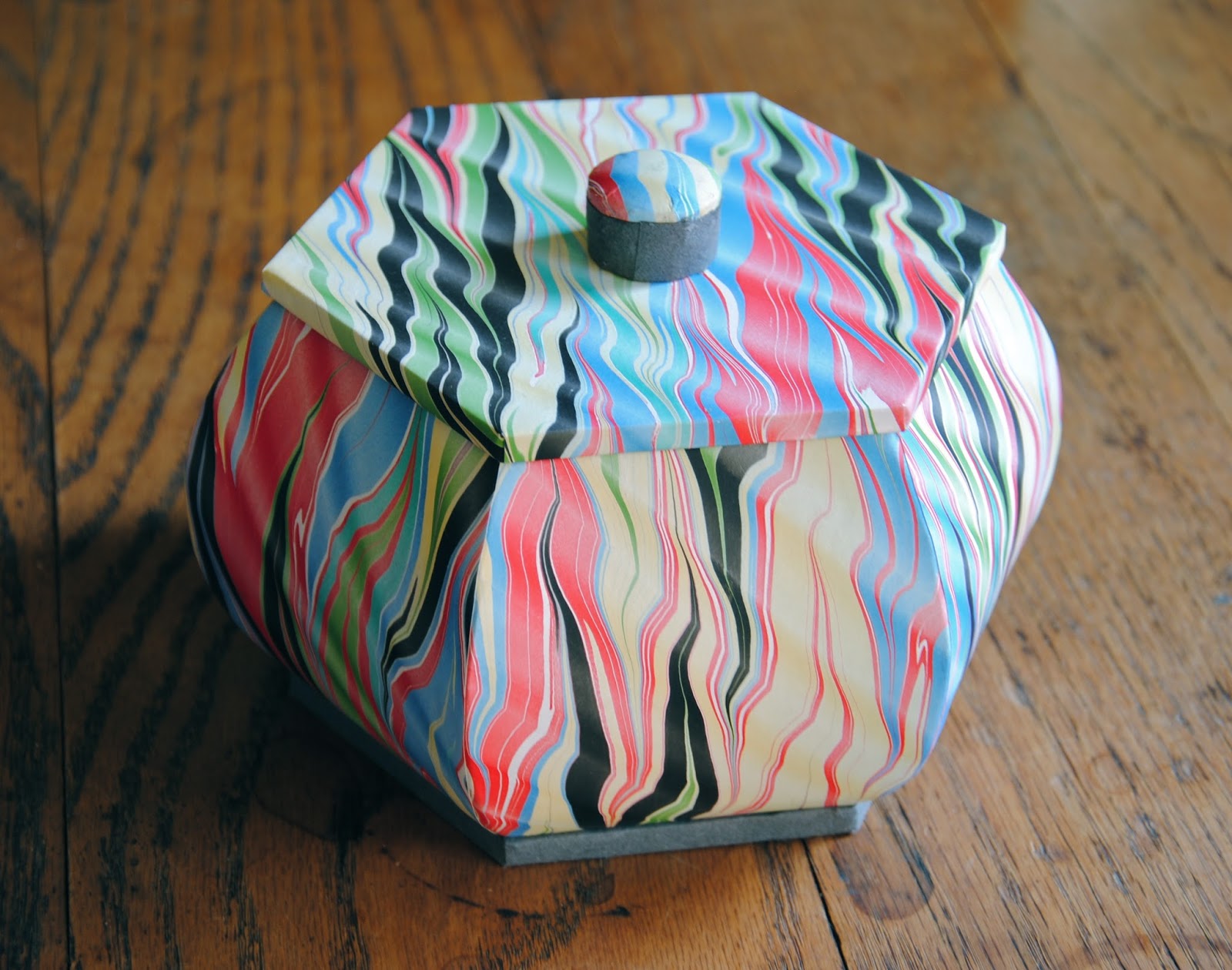
Back in July I took a box making workshop instructed by Steve Pittelkow.  During the class we made two different hexagonal boxes covered primarily in Steve's hand marbled papers.  I absolutely loved the class!  Box making requires precision, measuring, and repetition... three things I'm really good at!
The first day we made a box with three stacking trays that opens up similar to a jewelry box.  The first step was cutting out three hexagons out of board, leaving rectangular tabs on each flat edge for the tray sides.  Then we scored and folded up the sides of each tray and secured the corner edges with framers tape (also called paper tape.)  Each tray was covered with decorative paper like a book cover (only a little more complicated.)  The outside walls of the tray were covered first with a long strip of paper.  Then the inside bottom with a hexagon, and the outside bottom with another hexagon.  Last to be covered were the inside walls of the tray.  That process was repeated for all three trays and later the box lid.
After the trays were done, we created three "V" shapes out of board that matched the angle of the hexagon corners.  After a little fiddling we made the boards fit around the trays with enough space for hinges.  The trickiest part of the whole process was covering the V shaped boards with the same piece of paper, and folding over the edges.  The final step was attaching one tray to each segment of the box cover.

 On day two of the workshop we made hexagonal boxes with rounded walls, similar to a Chinese lantern or a pumpkin.  This box has a strong, hexagonal inner box and a thinner outer box with curved sides.  The thin pieces were cut individually from thin cardboard, and attached to a bottom hexagon like petals of a daisy.  Then we put the inner hexagonal box on the center of the daisy and bent each petal up so the top of the petal met with the top of the inner box.  The hardest part of this box was getting the curved edges to match up perfectly, and covering the seam with lots of tiny pieces of paper tape.

Once that part was done, it was just a matter of covering everything with decorative paper, and making a base and a lid.  I hope this post gave you a better idea of what goes into creating a box.  I am planning on taking a shorter box making workshop towards the end of September to learn more techniques for rectangular and square boxes.