Showing posts with label ecodye. Show all posts

Thursday, October 1, 2015

Dyeing Yarn with Goldenrod

This is a blog post I started last year, when I was in a yarn dyeing frenzy.  It sat as a draft with pictures for months and months... But last week I dyed with Goldenrod again (but forgot to take pictures) so I thought this would be a fitting post.  I have talked about yarn dyeing a few times on the blog, including this post with a more detailed description of the process.

Goldenrod is a wildflower (or weed, depending on who you ask) that grows in empty lots, along highways, and pretty much everywhere in Ohio in the late summer and early fall.  Last year a coworker filled a trashbag for me with the Goldenrod plants growing in his backyard.  This year I was able to scavenge some from an empty lot down by the railroad tracks.  Last year I used the flower, stems, and leaves to make the dye bath, but you can also get nearly the same color from just the flower heads.

I simmered the plant for about an hour before straining out the plant material.  I bought a big mesh ladle thing from the Chinese grocery store and it works great for this!  Meanwhile, I prepared my yarn by mordanting it in a solution of alum.  The yarn came out a beautiful, bright yellow.

I made a TON of dye that day, so I also dyed two additional skeins of yarn and treated them with an iron afterbath.  To get the iron solution I soaked a bunch of rusty nails and other metal bits in a jar with water and vinegar. Then I put the solution in a pot and heated it to almost a boil.  One skein I dipped from the dye bath into the iron bath for about 20-30 seconds (the color changes right before your eyes, it is amazing.)  That one came out a lovely light green.  The next skein I put into the iron bath for longer, probably 1-2 minutes, and it came out a dark forest green.

Thursday, November 20, 2014

Fiber Rituals - Art Book 5/14

I finished this book in late September for an Art Books Cleveland exhibition.  The exhibition just ended, and I was finally able to take photos of the book.  The theme of the exhibition was rituals.  I thought about it for months, came up with several ideas, but never actually started anything... I kept getting distracted by spinning wool and dyeing yarn.  That is when I realized that my book should be about the rituals involved with fiber- the things I had become obsessed about this summer!

I came up with seven different rituals associated with wool, and illustrated each one of them.  Scouring, mordanting, dyeing, carding, spinning, plying, and knitting.  The whole book is only about 4 inches tall.

To make the cover, I dyed strips of kozo paper with leftover plant dyes.  Then I spun the paper into thread using a drop spindle, and knit it into a rectangle.  It was my first time spinning paper and using it for a book.  It is a little tricky to get a nice thread without breaking or tearing the paper.  Compared to spinning wool, it is almost easier because you don't need to worry about drafting the fibers, you just need to give the paper twist.

I know I am way behind on my 14 Art Books for 2014.  It has been an interesting year to say the least, with several big changes in my life.  I have two unfinished art books sitting in my studio, and the ideas/materials for at least three more...  Time to get back in my studio and do this!

Tuesday, October 21, 2014

Dyeing Yarn with Queen Anne's Lace

Another one of my natural dye experiments this summer was with Queen Anne's Lace.  In the summertime Queen Anne's Lace is a wildflower that flourishes in empty lots, along highways, and any other green space that does not get mowed.  These flowers remind me of spending summer "up north" at my grandparent's cottage as a kid.  They grew everywhere and where my favorite flowers to pick.  Now that I am making natural dyes, I knew I had to use Queen Anne's Lace somehow.
 
I started by going down to the railroad tracks one August day and cutting giant handfuls of Queen Anne's Lace like I was making a bouquet.  I needed at least 4 oz. of flowers to dye one skein of yarn.  Then I went through the cooking process, strained off the flowers, and dyed 3.5 oz. of wool mordanted in alum.  (You can read more about the dyeing process on my these previous posts.)
 

So far this has been my favorite dye as far as aroma.  Since Queen Anne's Lace is in the carrot family, it has a kind of spicy carrot scent while cooking.  The final product ended up being a light, bright yellow.  Stay tuned for more posts about ecodyeing!  I've dyed about 30 skeins of yarn this summer and fall, and now that the weather is cooler I'm catching up on my blogging.
 

Tuesday, October 14, 2014

Kozo Book- Art Book 4/14

At the beginning of the year I set a challenge for myself to make 14 Art Books in 2014.  I got a little sidetracked by my job and other projects, but I am still plugging away at the 14.  I finished three art books for events and exhibitions in the month of October.  Here is the first of the books I made for October.

 
Art Book 4/14 is called the Kozo Book.  I made it for the Morgan Conservatory's annual benefit and silent auction.  The organization gives sheets of handmade paper to artists, and asks them to make a piece out of the paper to donate for the benefit.  This year the papers were handmade kozo paper with chiri, and a kozo/gampi blend.

I decided to continue my theme of books with stick bindings, and used kozo branches for the binding.  The pages ended up being too flexible for the book to stand up on its own, so I created a stand for it out of book board.  Finally, I added kozo leaves cut from some of my naturally dyed papers.
 

Friday, September 12, 2014

Dyeing Yarn with Blueberries

Another one of my natural dye experiments was dyeing yarn with blueberries.  I started with a skein of 100% wool yarn and pre-mordanted the fiber in Alum.  Mordant helps the yarn to accept color better, and Alum tends to provide the brightest and clearest colors, compared to using copper or iron as mordants.

I made the dye bath using a 1:1 ratio of berries to fiber.  In this case, the blueberries had been left behind in the fridge at work and had started to get wrinkly and soft.  Instead of throwing them in the compost, I took them home for dyeing.  To get the maximum amount of color from the berries, I added a small amount of water to the pot and crushed the berries with a potato masher.  (I did this without the water at first and ended up squirting berry juice everywhere...)
 
After keeping just below a simmer for an hour, I strained out the berry pieces and added the wet fiber.  The dye bath looked like a gorgeous pink/purple, and I was really hoping that would transfer to the fibers.  When the fiber was rinsed and dryed, it ended up looking more like a blue-ish lavender.  It is still a lovely color, but definitely shows how unpredictable natural dyeing can be.
 

Wednesday, September 3, 2014

Dyeing Yarn with Zinnias


As I mentioned in a previous post, my interest in natural dyeing has been renewed.  I have kind of gone crazy with dyeing yarn (which you will see in my next five... or ten... blog posts) starting with zinnia flowers from the garden.

I started out by weighing the flowers and getting a 2:1 ratio of flowers to fiber.  My skeins are 3.5 oz, and I also dyed a small amount of wool for spinning, so I used about 8 oz of zinnias.  Then  I simmered the flowers in my dye pot for about an hour to extract the color, and strained out the flower pieces so it doesn't tangle with the yarn.

The yarn is 100% wool, pre-mordanted in alum so it will accept the color better and be more light-fast.  Before adding the wool to the dye bath, I soaked it in water so it will dye more evenly.  After an hour or so in the hot dye bath, I removed the yarn, let it cool, and rinsed out the remaining dye.  The zinnia dye turned out to be a gorgeous buttery yellow, much more subdued than the turmeric.

Monday, August 25, 2014

Dyeing Yarn with Turmeric

So I actually dyed this yarn almost a year ago.  I had been putting off taking photos of the yarn and finishing the blog post... But now that I am getting back into natural dyeing and will be posting more of my experiments with natural dyes, I figured it was time to actually post this.

I participated in a local CSA program (community supported agriculture) which gives members a bag of fresh vegetables every week.  One week the bag included fresh Turmeric grown in the hoop house.  The turmeric root is bright yellow and usually used in curry and other similar dishes.  I already had a container of good ground turmeric in my spice rack, so I decided to use the fresh stuff to dye yarn.


I started by cleaning the roots and chopping them into small pieces.  The more surface area that is exposed, the easier it is to extract all the color available into the dye bath.  I added the chopped pieces to a pot of water and simmered for an hour or so to extract the dye.  (Note: I have a special pot set aside for dyeing, that is not used for food.)  I noticed that the dye wasn't very strong, so I supplemented the chopped roots with a teaspoon of ground turmeric from the pantry.

Luckily turmeric does not require a separate mordant to dye effectively.  Mordants prepare the fiber for dyeing so it can accept color from the dye bath.  Certain natural dye stuffs have a natural mordanting agent, so the fiber does not need any pre-treatment.  I took my ball of Paton's Classic Wool and wound it into a large loop so it could move freely in the dye bath.  After securing the loop, I soaked it in cool water in the sink to remove any bubbles or air pockets from the fiber (this helps the yarn dye more evenly.)


I turned the stove down and added my fiber to the dye pot so it could simmer for an hour or more.  I also added some wool roving to the dye pot, so I could use it for spinning later.  As an experiment I dipped one section of roving into an acidic solution (vinegar) after the dyeing process, and one section in an alkaline solution (baking soda and water.)  Treating dyes fibers in different pH solutions will change the color.  One section of roving turned brighter yellow and the other turned a little redder, and shifted towards orange.

Apparently I fail at documenting my process in photos... Because this is all I've got.  Don't worry, I've done a lot more dyeing since then and I (sort of) got better about taking photos.  Stay tuned for more posts about natural dyeing!

Wednesday, March 12, 2014

Multiple Stick Book- Art Book 1/14

Remember back in January when I introduced my 14 Art Book in 2014 project?  Well, I finally got around to making my first art book of the year!  January and February were really tough months for me this year.  I had a lot of trouble getting motivated to do things, and spent most of the time curled up on the couch knitting.  (Which is why I have so many knitting posts lately...)  I'm also a competitive figure skater, so this is my peak training season before competition.  Between all of that I did not have time to physically make any art books... But I was planning!

This month I am really kicking things into gear with art books.  I have been invited to be part of a gallery exhibition of book and paper artists that opens in late April.  The artwork deadline is fast approaching and I only have one piece ready for the show!  Yikes!

To get ready for the show, I made a list of pieces I already have and pieces I would like to create for the show.  I want to continue the two themes I've already started with my art books: curly willow branches with ecodyed papers, and Astronomy.  Last week I spent some time after work dyeing papers for future books.  On Monday I had the day off and spent most of the day in my studio.

http://www.flickr.com/photos/25370403@N08/13104976704/in/photostream/
I started by spraying down my new ecodyed papers with water and pressing them under weights to flatten.  I had two sheets of dyed paper from last fall that were already flat, so I used those for the first book.  Then I sorted through my stick collection and found some lovely, skinny, wavy ones.  The idea was to create a multiple signature stick book with one stick for each signature.

http://www.flickr.com/photos/25370403@N08/13104705335/in/photostream/
Once I had my 5 ideal sticks, I tore down the two sheets of dyed paper to 4 1/2 x 6 inch pieces.  I supplemented that with 5 sheets of handmade abaca paper that I made a few years ago.  Then I leafed through my old dictionary and cut out several botanical images for transfers.  Normally I use a blender pen to transfer images that have been through a copy machine, but this time I used the original image and rubbed very hard for a light transfer.  For the covers I used embroidery floss in complementing colors to sew together two smaller pieces of dyed paper.  (Two pieces for each cover.)

http://www.flickr.com/photos/25370403@N08/13104971464/in/photostream/
The hardest part about this book was sewing the signatures to the sticks.  It was tricky figuring out where to attach each stick and how to get the signatures connected securely without much wiggle.  I ended up just winging it, and I think it added to the organic look of the whole book.  I'm very excited with how the book came out, and I think I like it even better than my original Curly Willow Book!
http://www.flickr.com/photos/25370403@N08/13104969144/

Thursday, September 5, 2013

Curly Willow: Book 191

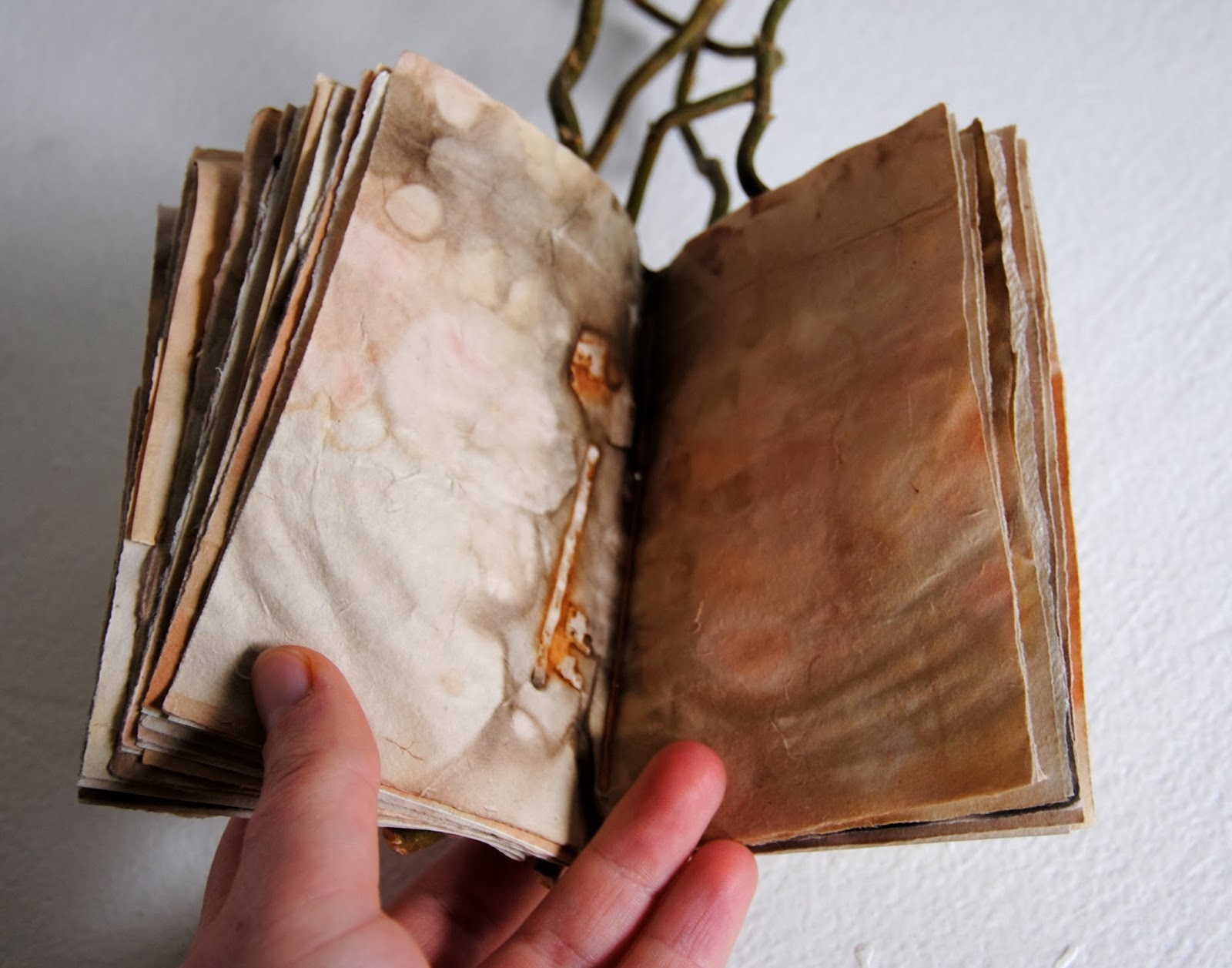
Remember when I posted about ecodyeing paper way back in July?  Shortly after dyeing those sheets of paper I needed to submit a piece of artwork for a juried show.  That week, things came together and I created an art book using the dyed paper, handmade paper, and a curly willow branch.

The curly willow branch was given to me by another artist earlier in the summer.  I had been saving it to use for a "stick binding" where a single signature of pages gets sewn around a stick.  The stick binding didn't seem appropriate for most of the books I had been making this summer, but the ecodyed paper was exactly what I had been waiting for!  I alternated sheets of handmade flax paper (that I made in 2011 during my internship at the Morgan Conservatory) with the ecodyed paper.  The flax paper has a lovely translucent quality that allowed the patterns from the dyed paper to show through.
Some of the pages had gotten torn and developed holes during the dyeing process.  I used earth toned embroidery flosses to sew over the damaged pieces of paper.  This functioned both as a repair and a decorative element.  The cover is a piece of recycled leather someone had been given to me years ago as scrap materials (I believe it was part of a thrift store leather jacket.)  Lastly, I sewed my folded signature and cover around the stick.

The piece was accepted into the show Rags Make Paper at the Morgan Conservatory in Cleveland.  The opening reception was on August 9th, and the show runs until September 14th.

Friday, August 9, 2013

Ecodyeing: Paper and Yarn

July was a very busy month for me in terms of art. Basically, I've been making things faster than I could possibly blog about them! In an effort to catch up, I'm writing a bunch of blog posts this week about my recent projects.
As part of my job at the Morgan Conservatory I have the opportunity to meet many wonderful artists, specifically in the areas of paper, print, and book arts. One of the artists that came through recently was Velma Bolyard. She spent the weekend in Cleveland teaching a workshop on ecodyeing, and I was around to take pictures and watch the process. The workshop students layered plant material, paper, and occasionally pieces of metal, tied them up with string into bundles.  The prepared bundles get boiled in a large pot of water for several hours. The best part of the process is unwrapping the bundles and rinsing off the plant material to reveal the patterns and colors left behind by the plants.
I was around that weekend observing the process, and Velma encouraged me to make a couple bundles of my own. I used scraps of the cotton paper I usually use for book pages. The paper tore in a few places, but the results were still thrilling! I ended up using the dyed paper as part of an abstract art book.
While cleaning up after the workshop, there was still a large bag of Staghorn Sumac leftover. I took a gallon Ziploc full, and used it to dye yarn the next day.
I've dyed yarn before, but this was secondly the best end result. Mostly because the Sumac has natural tannins that act as a mordant for the yarn.
The fuzzy red bunches from the Sumac created a lovely brown dye bath (and actually smelled really nice while cooking.) I dyed one skein of white wool yarn, and a chunk of wool roving for spinning. The process took the whole day, but it was definitely worth it.